Vol. DCCXXXV · No. 16 Weather: Fog. Thunder when certain names are spoken. Price: One Silver · Ten at Bildrath's

TheBarovia Gazetteer

All the News the Count Permits

The woman who sold dream pastries door to door in this village, and who was last seen in it being carried into the Burgomaster's wine cellar tied to a chair, is dead. She died on the road between the Tser Pool and Vallaki, a little below the old Durst windmill, at the hands of the same six strangers who tied her to the chair. The Gazetteer has this from the strangers themselves, who are not shy, and from the Vistani of Tser Pool, who are never shy.

She was travelling south toward Vallaki pushing a small cart, hooded and cloaked and dressed, by every account, to be mistaken for an old man. There was flour on her sleeves. The pastry compartment of the cart was empty; she had, it seems, already made her rounds. When she saw who stood in the road she stepped into the ditch, put her head down and quickened her pace. No sir, no sir, she is reported to have said, to nobody in particular.

It did not serve. The goliath among the strangers took hold of the peddler and did not let go for the remainder of the affair; she is said to have tried, repeatedly, and to have moved him not at all. Witnesses agree the first blow shook the old man's face off her and left the face beneath, which was the face the village knows from its doorsteps.
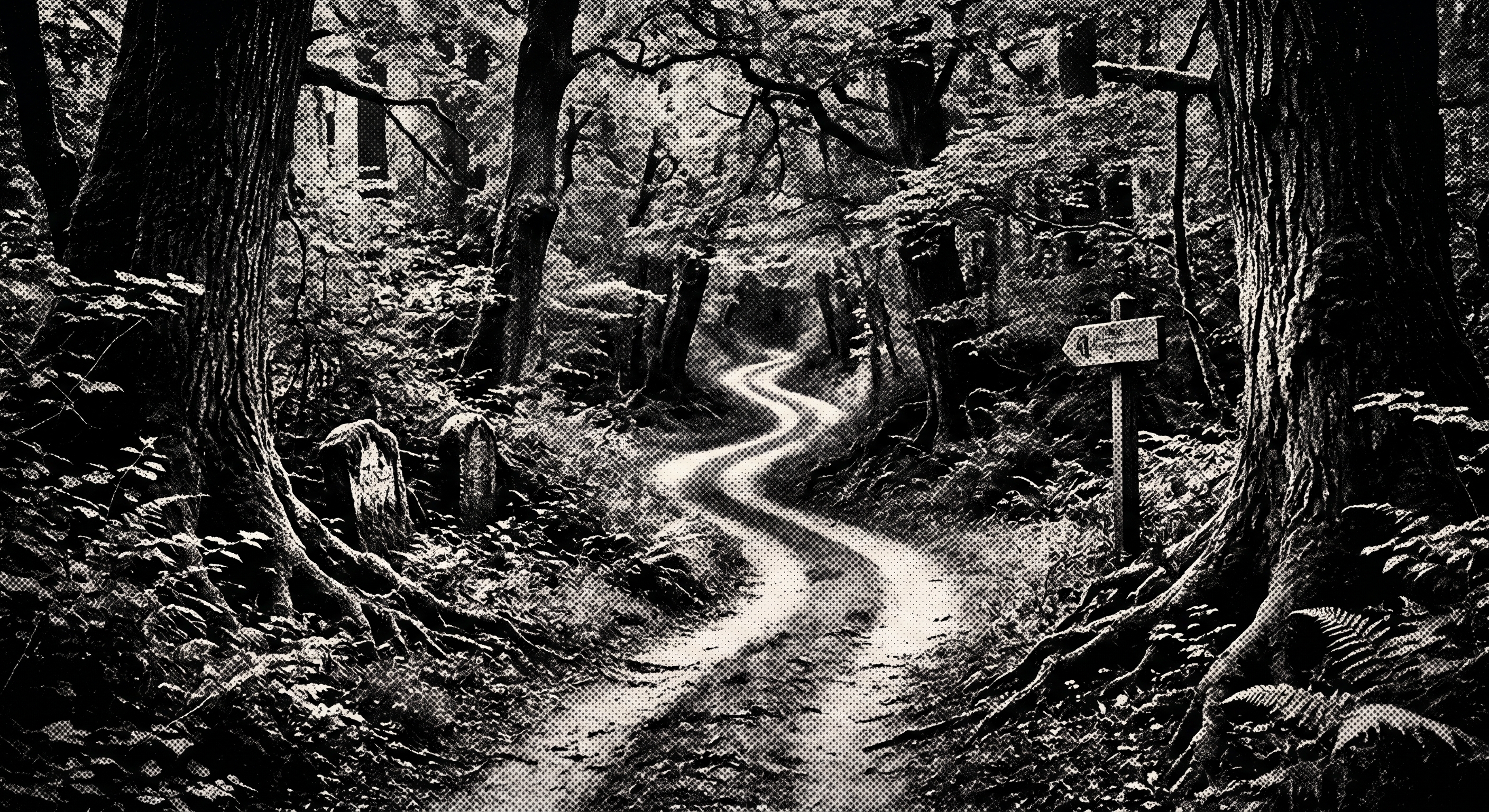
A rutted road winding through dark woods toward the Durst windmill, a signpost at the roadside.
The road below the Durst windmill, where the peddler was stopped. The mill's sails have not turned in living memory, and nobody has asked why.

Silver, Lightning, and a Promise

Ordinary steel did the peddler little harm, a fact this paper reports without comment. A silvered shortsword in the hands of the halfling was another matter; those present describe the flesh smoking where it touched. The elf woman kept a bolt of lightning on her for the better part of a minute. The peddler answered with a handful of small magics and a thrown vial, which the goliath shrugged off, and which appears to have been the only vial she had.

The end came from the goliath. He ran his sword up through her and out of her mouth, and said, for the record, I'm keeping my promise. Readers with long memories will recall that a promise of release was made to the peddler in the Burgomaster's cellar some nights ago, and that she left the cellar without it being kept. It has now been kept. The Gazetteer takes no position on whether this is the sense in which it was meant.

What Was on the Body

No gold. Not a copper. Roughly a dozen dream pastries, which the strangers have kept and, so far as this paper can learn, not eaten. A second sack of the same unusual make as the one taken from her in the village, which grows light when a child is put inside it. Her clothes, which one of the strangers has since put on. Her right hand, which one of the strangers has taken for purposes the Gazetteer declined to have explained.

The peddler was not the only occupant of the windmill. Scouts who crept within sight of it before the killing counted three grown women moving inside, a dog on a short chain at the door, and the sound of a child crying. Two women, then, remain. They do not know their third is dead. At the hour this edition went to press the strangers were walking up to the mill door wearing the dead woman's clothes and carrying a sack that struggled, and the dog had begun to bark. The Gazetteer will report what the door says.
The Road

Sixteen Wolves Slain on the Tser Trail; Vistani Decline the Pelts

A pack of twenty-two takes a bear on the shortcut trail, then tries the strangers. "Not sure I want to wear a wolf like that," says Petyr Romani, "and piss off the lord."

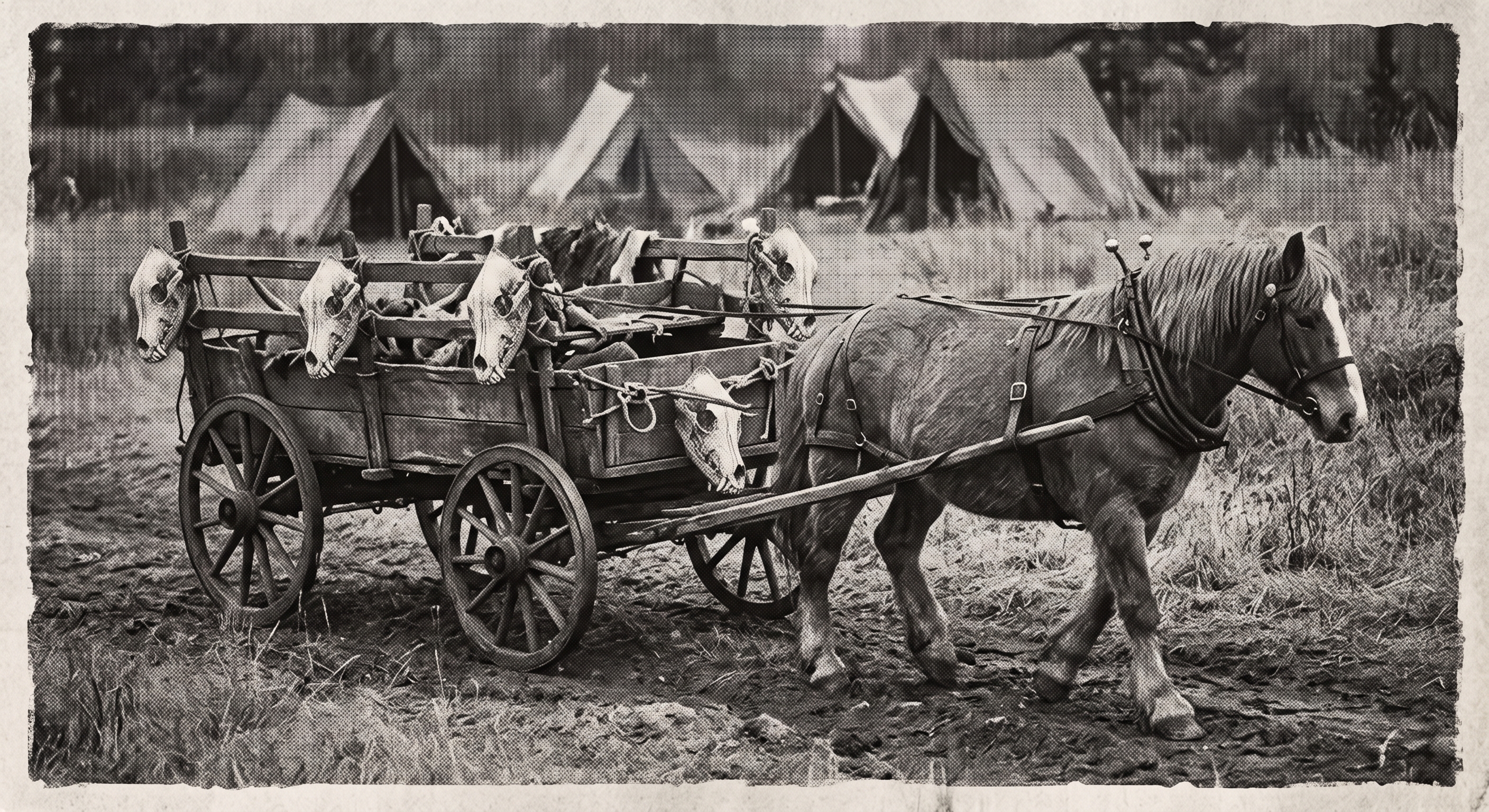
A horse-drawn cart at the Vistani camp, wolf skulls mounted along its rails and a bear skull at the front.
The strangers' cart, as it now travels: a bear's skull on the front board and the skulls of wolves along both rails, boiled clean by the goliath. Whether this is a warning or an invitation is a matter of opinion.

The wooded shortcut between Tser Pool and the Old Svalich Road has always been the quicker way and the worse one. The strangers found the bear first. A brown bear, grown, dead less than a day, reduced to a skull and four paws and a scatter of bone. The tracks around it were canine, too small for dire wolves, and there were more than ten sets of them. The strangers read this correctly and went on anyway, which is the Barovian thing to do and is why we bury so many Barovians.

The pack came out of the brush in two waves. It did not fight so much as bite and leave, drawing the big fighters forward and working the edges for anyone who fell behind. The half-orc pounded her chest at them and would not be moved. The elf put an arrow at the lead wolf's feet, and one wolf, to its credit, took the hint and left. The rest did not.

They found the halfling. She went down, and two of them took her by the cloak and the leg and dragged her for the treeline at a run, and the Gazetteer is told she was one more heartbeat from the woods when the elf woman withered every plant within reach and put the life of it into her. She woke in a wolf's mouth. She does not recommend it.

The pack broke when the half-orc's thrown axe dropped one more than they could stand to lose. The priest's beam of moonlight took several on the way out. The halfling caught the last by the tail, hauled it back, and cut its throat personally. Sixteen dead of twenty-two. The remaining five or six went into the trees, and a day later, on the road to the windmill, a flock of birds went up half a mile behind the cart for no reason anybody could see.

Petyr Romani, who was offered the lot, buried them by his rubbish heap and paid the strangers one gold piece for the defence of the camp and a second, at the priest's request, for the priest's god. They are Strahd's business, he said, and I stay out of Strahd's business. The Gazetteer notes that the young woman travelling with the party then accused the Vistani, at some volume, of having sent the wolves; that Mr. Romani, asked who else could send wolves, pointed up the road at the castle without saying anything; and that she apologised to him afterward, which is rarer in this valley than a bear.

Scholar Says the Castle Sits on Older Bones

The halfling's reading of the valley's stonework puts Ravenloft at four hundred years and the village gates a good deal older than that.

Miss Petra Hollowfield, who describes herself as a curator, spent an afternoon at Tser Pool drawing Castle Ravenloft in a journal and has reached conclusions the Gazetteer is in no position to check. The castle, she says, is some four hundred years old and stands on the razed foundations of an older one, in the manner of a conqueror who wishes the conquered to look up every morning and be reminded. That older castle belonged to a people who are no longer here.

More interesting to this village: she holds that the great stone gates and walls of Barovia are of the same older work, and predate the castle entirely. Readers who have walked through those gates every day of their lives and never wondered who built them are invited to keep not wondering. The strangers passed through the old gates on the Svalich Road on their way to the windmill, and crossed the Tser Falls bridge above the gorge, a thousand feet of stone with the cold mist coming up through it, and noted that neither bears any inscription. Whoever built them did not expect to need one.

The same halfling reports four standing stones in a square on the far side of the windmill's hill, set with intent. She did not go near them. The Gazetteer would not either.

The Village

Burgomaster Laid to Rest; Daughter Not Seen Since

Kolyan Indirovich is buried at the Church of the Morninglord, in a grave dug for a coffin and filled with an urn. The sounds beneath the church floor have stopped.

The late Burgomaster was interred in the churchyard on the second morning after the strangers came to the village, Father Donavich officiating. The rites were spoken. The grave had been dug, in the usual way, for a coffin; the Burgomaster arrived instead in an urn, the strangers having burned the body in the mansion the night before, out of what they described as a concern for his getting up again. The village has views on cremation. The village kept them to itself.

His daughter, Miss Ireena Kolyana, stood at the graveside, said At least it's done, and has not been seen in the village since. The Gazetteer understands the mansion door was left unlocked. Holy symbols remain nailed to its exterior, and there are ropes across the garden path at shin height that the Gazetteer advises visitors to mind.

Of the church itself, this paper will say only what anyone walking past can see: one of the stained glass windows facing the cemetery is broken outward, the pews are not where they were, and the trapdoor in the floor, which was chained, is no longer chained. Sounds from beneath that floor had for some months been the subject of village talk. They have stopped. Father Donavich has made no complaint, and the Gazetteer, having heard the hymn that was sung in that church the same morning, has made no inquiry. There is a vase on the altar that was not there before.

Durst Manor Burns; Nobody Sorry

The old house on the farm road is gone to the foundations. The strangers say they never went in.

Six days ago the manor of the Durst family, empty for longer than anyone will say, burned to the ground in the early morning with a thoroughness that surprised those who had assumed it could not be got rid of. The six strangers were seen leaving it. Asked about this at the Blood of the Vine, they explained that they had noticed two children smoking outside the house, had judged the house unwise, had declined to enter, and that it had caught fire on its own shortly afterward.

The proprietors of the Blood of the Vine accepted this account. The Gazetteer prints it as given. It notes only that the deed to the Durst family's windmill, which the strangers are now visiting, is said to have been in that house, and that if it was, it is not any more.

A Vistani merchant who was waiting outside the manor with a cart at the time of the fire is reported to have said, Of course it's haunted. It's the Death House, and to have offered the survivors a ride into the village, which they took.

Elsewhere in the Valley

Commerce

Holy Water at Two Hundred and Fifty Gold; Bildrath Unmoved

The strangers offered jewellery, an ivory comb, and argument for a single vial and came up a hundred and ninety-five gold short. I know what it costs to get anything into this valley, Mr. Cantemir told them, and I know how long it has to last. A steel mirror, fifty gold asking, went missing from the shelf the same afternoon. Mr. Cantemir asked whether anyone wanted to buy a mirror and let the matter rest. A rival supplier of holy water is rumoured. Mr. Cantemir has offered thirty-five a vial for it. They want fifty.

Parriwimple was present throughout.

The Vistani

Accordionist Tells of the Wizard Who Called Down Lightning "Like a Hand"

Regalus of Tser Pool set down his accordion halfway through a tune to tell the strangers of a wizard who came into the valley some time ago to challenge the castle and lost. The lightning did not come down the way lightning comes down, he said. It came down like a hand. Like someone was reaching. The wizard is said to live still, in the northern mountains, arguing with people only he can see. Nobody at the fire would give his name. The accordionist picked the tune back up in a lower key.

The Tavern

Proprietors of the Blood of the Vine Cast Reflections; Patrons Reassured

The strangers, having left the tavern, returned to it at a run with a small steel mirror and held it up to Alenka, Miravel and Sorvia in turn. All three appeared in it. The strangers then checked their driver, his horse, and the young woman travelling with them, who has now been checked twice. The elf among them observed that a certain gentleman would not appear in any mirror, wig or no wig, and the party was some minutes recovering. The Gazetteer confirms the tavern is under Vistani ownership, that the three ladies are cousins, and that they are very interested in everyone.

Livestock

Horse and Cart Sold at Tser Pool; Horse Is Not a Princess

Eighty gold and a bag of dire wolf teeth bought the strangers a draft horse and cart from a Vistani of Tser Pool, water barrel included. The horse was named Clip Clop, then Princess Clip Clop, then examined. He is a gelding and answers to all three. On the morning of departure the half-orc took the reins and drove the party the wrong way for ten minutes, past the entire camp, at dawn, with the skulls rattling. The camp watched them go and watched them come back.

Bram Staker has since put the horse to sleep once, on purpose, to stop him bolting. The horse has no comment.

Obituaries

The Gazetteer records the dead as it is able. Notices are free. So is the ground.

Kolyan Indirovich Burgomaster of the Village of Barovia. Died at home of what came to the house. His body lay in the mansion for some days because it was too heavy for his daughter to carry alone and only one man in the village came to help. He was burned by strangers and buried by a priest. Survived by his daughter, whereabouts unknown.

Doru son of Father Donavich. Went up the road to the castle with a party of villagers some months ago and was the only one to come back, and did not come back. Kept beneath the church by his father, who fed him what he could. Died in the churchyard, a third of the way to the cliffs. Before he went out through the window he stopped to see that his father was still breathing. He was. Cremated. His ashes are in a vase on the altar, with a note.

Morgantha peddler, of the Durst windmill and no fixed address. Sold dream pastries in this village and took payment in kind. Died on the Vallaki road of a promise. No coin was found on her person. Her customers are asked to make other arrangements. Survived by two others at the mill who have not yet been told.

Sixteen Wolves of the Svalich Woods. Buried at Tser Pool by the rubbish heap. Their heads are elsewhere. A family notice will not be placed; the family is still out there.

A Brown Bear of the shortcut trail. Skull and paws recovered. The skull rides on the front of a cart.

Letters to the Editor

The Gazetteer prints all correspondence it receives, and some it does not.

Sir, — I write regarding the Burgomaster's mansion. There are holy symbols nailed to the outside of it at a height I can only describe as goliath. There are ropes across the garden at the height of my shins. I have gone over twice. I do not object to the strangers fortifying the house; I object to their leaving.

— A Householder with a Bruised Knee

Sir, — We are not sisters. We are cousins. We do not "love money"; we love being paid, which is a different thing and one the halfling might learn. We would also like it known that we have reflections and did not need them checked. Come back any time. Bring the elf.

— A., M. & S., the Blood of the Vine

Sir, — A mirror is missing from my shelf. I know exactly which one. I know exactly when. I am not asking for it back. I am asking the person who has it to remember, the next time they need rope at the price rope costs here, that I remember too.

— B. Cantemir, Merchant

Corrections

In an earlier edition the Gazetteer described the three proprietors of the Blood of the Vine as sisters. They are cousins. The Gazetteer also described them as casting no reflection. They do. The Gazetteer regrets the error and the halfling.

The Gazetteer reported that the strangers' horse was female. He is not. The Gazetteer is informed this has been noted, considered, and firmly ignored.

The Gazetteer printed a fee requested by Madam Eva of Tser Pool. It has since been struck. The Gazetteer regrets printing it and would do so again.

Word from the Street

"You Cannot Dry a Sheet in This Valley"

The Gazetteer stops a passer-by and asks how things are. This week: Ludmila Voshka, widow, of the lane behind the tannery, who keeps geese and was carrying one.

Gazetteer: Mrs. Voshka, how are things?

Mrs. Voshka: Wet. You cannot dry a sheet in this valley. I have had the same sheet on the line since the thaw. It has gone from white to grey to a colour I would call fog, and now I think it is holding the fog up rather than the other way round. My mother could dry a sheet. She said there used to be a wind. I do not believe her, but I would like to.

Gazetteer: Have you noticed anything unusual lately?

Mrs. Voshka: Unusual. No. There was a cart went through with skulls nailed on it and a horse that looked embarrassed. My goose has not laid since. I do not say the two are connected. I say the goose has an opinion.

Gazetteer: Anything you would like answered?

Mrs. Voshka: Where do the crows go at noon? All of them, at once, every day, and then they come back and sit on the priest's roof as if nothing happened. Why does the well water taste of coins on the days it rains, which is the days? And who keeps oiling the hinge on the east gate? It has not squeaked in eleven years. Nobody in this village oils anything. Somebody is oiling that hinge.

Gazetteer: Any complaints?

Mrs. Voshka: The midnight procession walks through my cabbages. Every night. Straight through the middle, up the road to the castle, and back through the cabbages. I have moved the cabbages. They walk through where the cabbages were. I have written to the Burgomaster about it, but he is dead, and the letter came back.

Also a candle is three silver at Bildrath's now, and I said to him, Bildrath, it is a candle, and he said, I know what it is, Ludmila. That is the whole conversation. I have had it four times.

Gazetteer: Anything else?

Mrs. Voshka: No. That is everything. That is my whole life, a sheet and a goose and some cabbages that get walked on. [Mrs. Voshka here looked over the Gazetteer's shoulder, then over her own, then at the goose.] Except of course that all of it, the fog and the well and the cabbages, is as it should be, under the wise and merciful stewardship of our Lord in the castle, whose patience with us is a lesson, and whose hinge, if it is his hinge, is a very good hinge. Long may he. Is that enough? Can you write that I said that part loudly? Write that I said it first.

The Gazetteer thanks Mrs. Voshka and the goose, and confirms that she said it first.